
Catherine Mayer.
Catherine Mayer is an award-winning journalist, author, and activist.
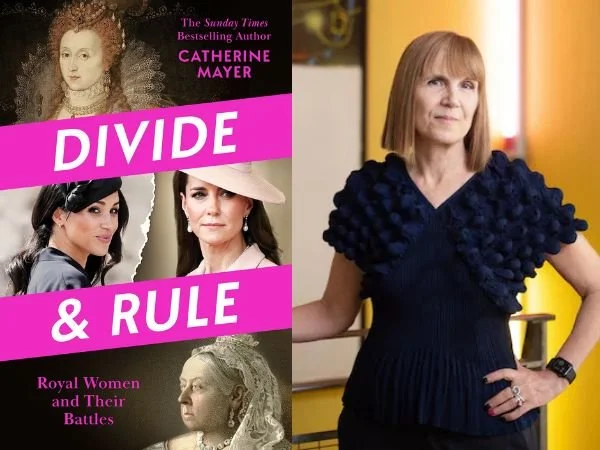
Her latest book, Divide and Rule: Royal Women and their Battles(2026), examines how royal women from Anne Boleyn to Meghan, Duchess of Sussex, have been pressed into service as combatants in culture wars and vehicles for disinformation. She has also written a bestselling biography of the King, Charles: The Heart of a King (2015, 2022) and joined ITV’s line-up for the ten days of public mourning after Queen Elizabeth’s death and again for Charles’s coronation. Three of her books,Amortality: The Pleasures and Perils of Living Agelessly(2011) about the science and social attitudes relating to ageing, her memoir of loss, Good Grief: Embracing Life at a Time of Death(2020), and Attack of the Fifty Foot Women: How Gender Equality Can Save the World! (2017) provide insights into some of the biggest questions of our times, including how to live and lead well and with humanity. Her novel Time/Life (2025),a reworking of H.G. Wells’ The Time Machine, draws on Catherine's experience as the director of a technology think tank, her journalism on technology and her long-term involvement in pushing to maximise the benefits and minimise the risks of new technologies including AI. She is a frequent commentator on current affairs and participant in multiple documentaries.
She co-founded the Women’s Equality Party with Sandi Toksvig and the award-winning Primadonna Festival. After the death of her husband, musician Andy Gill, she has taken on management of his estate and put out several music releases including a double album in tribute to him.
Catherine began her career at The Economist and served as TIME's London Bureau Chief, Europe Editor and Editor at Large. Her career has bridged media, leadership, and creativity, from shaping public debate through her writing to performing original work on stage. She continues to bring her curiosity and conviction to projects that champion equality, culture, and human connection.
keynote speeches.
-
As a veteran journalist, bestselling author, administrator of a music estate, former director of the technology think-tank Datum Future and founding member of the Society for Hopeful Technologists, Catherine is uniquely placed to unpick the impacts of AI and other evolving technologies across the creative industries and beyond, and to point to ways to realise their potential. An early adopter of new technology, she navigated the digital revolution that simultaneously expanded journalism and eroded the business models that sustained it. She has met and interviewed key innovators, spent time inside some of the biggest tech companies, written extensively and thought deeply about the perils and possibilities of AI, social media and other data-driven technologies - and how they are changing us and our world.
Key Takeaways
Before exploring how AI can support creativity, Catherine asks the harder question first, are we at risk of outsourcing our imagination entirely, and what would we lose if we did?
She looks at their potential use and misuse as aides to creativity, whether in traditional business settings, education and domestic spheres or the creative industries themselves
Drawing on her own extensive history of managing technological transformations, she offers insights on how organisations and individuals can make the most of AI - and what not to do
-
Catherine has documented the monarchy for more than four decades, spent time with the most senior royals behind the scenes, written a bestselling biography of King Charles, accompanied the then Prince Andrew to China on one of his missions as trade envoy, and has now distilled many of her insights and years of in-depth research into a new book, Divide and Rule: Royal Women and their Battles, which uncovers eerie echoes in the trials and tribulations of royal women from the Tudor era to the present day. In her view, the Windsors and their institution are often royally misunderstood as a tourist attraction or form of celebrity soap opera. Her talk peels back the layers of confusion and secrecy that shroud them to reveal a monarchy with substantial influence and reach and thinning ranks of leading members confronting external challenges and existential threats of their own making.
Key Takeaways
Catherine charts her own history with the Windsors which began with meeting then Prince Charles in 1985 and eventually gave her access to most senior royals and members of their inner circles
She describes the startling differences between their world, “Planet Windsor”, and ours, and how these complicate everything from royal marriages to the jobs of palace PRs
She makes the case for looking at the institution not as a sideshow but an arm of state not only in the UK but overseas territories and realms, and for understanding the royals themselves as representatives of soft power with significant reach and influence - for good or ill - and often fascinatingly different to their public images
-
There is something much more damaging than saying the wrong thing to the newly bereaved—saying nothing at all. Not that there’s much value to mumbled platitudes or ill-timed expressions of sympathy. Grieving people often crave the semblance of normality that returning to work can provide and may not wish to be forced to answer questions about how they’re feeling; on the other hand, they will need more support than they may realise. Catherine talks about what she’s learned from dealing with the bereaved and from her own widowhood and other losses.
Key Takeaways
Catherine explains how she has navigated serial losses including of her husband of three decades and what this has taught her about grief and trauma and the differences between them
“How are you?” She reveals how unsettling this seemingly caring question can be - and lists some of the questions and acts of care that are more reliably helpful
She talks about the impulse of the grieving to seek normality by returning to work and what every colleague and organisation needs to know - and encourages frank discussion and questions from the audience about such situations and their own experiences of loss
-
Until recently, organisations scrambled to show how well they were doing at implementing diversity, equity and inclusion programmes. Now a backlash against DEI is seeing programmes ditched or watered down. While some criticisms were valid - DEI has always risked being little more than a box-ticking exercise and some policies carries unintended consequences - the arguments for true DEI to organisations, the people who work in them and wider economies and societies remain powerful. These include recruiting and enabling the best talents which in turn fosters growth, innovation and dynamic work cultures. Catherine has written and researched deeply in this area and can also speak to her learning curve as co-founder of the Women’s Equality Party, not only in terms of policies the party advocated but its own tussles with these issues.
Key Takeaways
DEI is dead. Or is it? Catherine hails the possibility of its rebirth, shorn of platitudes and focused on the real, measurable benefits to organisations and staff of recruiting, retaining and enabling the best talents
She draws on her own experience of helming organisations and founding start-ups to highlight the benefits of drawing on wide-ranging experiences and perspectives and the dangers of groupthink
She blends deep research with illuminating case studies and anecdotes to make the case for reinventing DEI for better organisational outcomes and in the creation of stimulating and humane working environments

videos.
Showreel
books.


in the news.

frequently asked questions.
-
Catherine focuses on equality, feminism, political advocacy, communication, and grief, exploring how power, identity, and human experience shape organisations, public life, and institutions — from workplaces and social movements to politics and the monarchy.
-
Catherine is typically engaged for keynote-style sessions within conferences and culture-focused events, including festivals, public forums, and corporate programmes exploring equality, identity, and social change.
-
Beyond keynote presentations, Catherine can also contribute to moderated conversations, panel discussions, and facilitated dialogues, drawing on her experience across politics, media, cultural institutions, and corporate settings to explore inclusion, culture, and communication.
-
She engages with a wide range of audiences, including corporate audiences, public institutions, cultural organisations, third-sector groups, and public-facing conference and festival audiences.
-
Her approach is thoughtful, engaging, and insight-led, combining journalism, political advocacy, lived experience, and cultural analysis to challenge assumptions and encourage reflection and dialogue.
-
She adapts her content to audience context and organisational culture, drawing on experience across politics, media, cultural institutions, and corporate settings to ensure relevance, depth, and practical understanding rather than ideology.
-
Catherine’s themes around equality, feminism, communication, and public life resonate strongly across international and cultural contexts.
-
Pricing for Catherine is influenced by factors such as event location, format, and time commitment. Speaking Office ensures fee consistency across all enquiries, whether via speaker bureaus or direct clients, so that pricing remains aligned and non-competitive across channels. Accurate and up-to-date pricing can be provided once event details are shared, ensuring alignment with both the client’s requirements and Catherine’s long-term positioning.
-
Speaking Office aims to respond promptly to all enquiries regarding Catherine typically within one business day. Response times may vary slightly depending on event complexity and time zone, but all enquiries are handled with care and attention.
-
Catherine is available for virtual and hybrid events, as well as in-person engagements, depending on availability and event requirements. Speaking Office can advise on the most appropriate format based on audience, objectives, and technical considerations.
-
Advance booking is recommended for Catherine, particularly for peak periods and international events. While shorter lead times can be accommodated, early enquiry allows for greater flexibility and planning.
-
Speaking Office exclusively represents Catherine for speaking engagements and live events work. Details regarding availability, fees and general enquiries are managed by his speaker manager via the contact information on this page.
How do I book Catherine for a speech?
Speaking Office exclusively represents Catherine Mayer for speaking engagements.
To discuss arrangements, please contact Speaking Office: